A good notebook that happens to be smart.
We did not set out to build another app that wants your attention. We set out to build a quieter kitchen.
Most cooking tools are loud. Ceres is meant to be calm.
The kitchen already asks a lot of you. What to make, how much to buy, whether it adds up to something reasonable by the end of the week. Most software answers this with more, not less. Feeds to scroll. Streaks to keep. A prompt box waiting for you to do the work of asking, again and again.
We wanted the opposite. Ceres is a personal kitchen, not a platform. It holds your recipes the way a good notebook would, and it happens to be smart enough to plan the week, write the list, and count the nutrition when you ask. The intelligence is real, but it stays in the back. What you see is a plan that simply makes sense.
Nothing here is fighting for your attention. There is no home feed, no badge, no nudge to come back. You open Ceres when there is a decision to make, it helps you make it, and then it lets you go and cook.
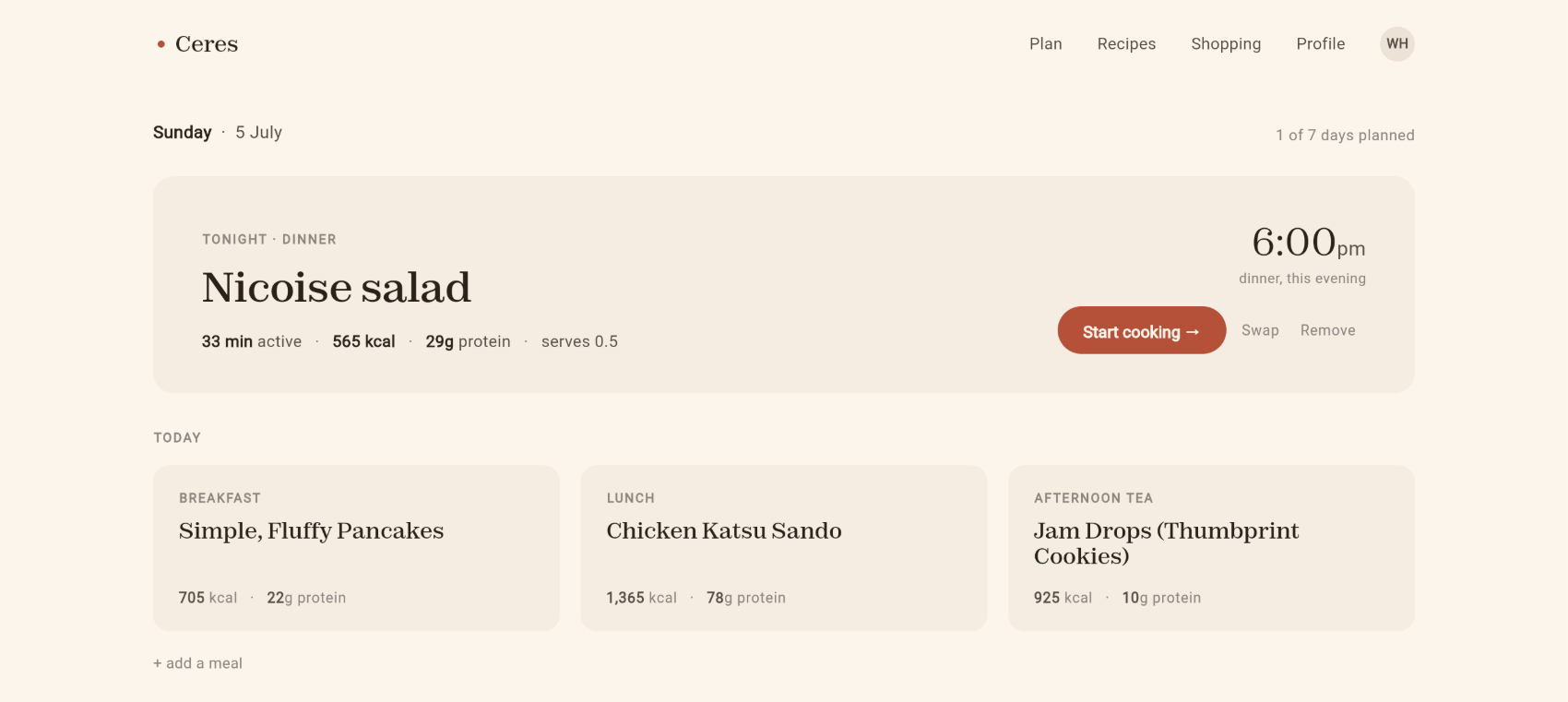
The home screen. This week's plan, tonight's cook, and the day's numbers. Nothing more asked of you.
What we hold to.
The software should do its work and step back. No notifications begging for a return visit, no gamified streak to protect. If Ceres has done its job, you barely think about it.
You are not the product and your evening is not inventory to be filled. Ceres opens to a decision, helps you make it, and closes. There is nothing to scroll to the end of.
Nutrition is a total, not a scoreboard. We show the day's calories and protein as a plain consequence of the meals you chose, without turning eating into a game to win or lose.
Ceres plans around the food you actually like and already cook. It is not here to reform your diet or sell you a program. It remembers your kitchen and works from it.
The food looks like dinner you cooked, not a magazine shoot. A crumb, an off-center herb, warm kitchen light. Real, so the plan feels reachable.
If it feels like less, we built it right.